Inspiration
The Most Beautiful Wedding Venues in the UAE
City, coast, desert and mountain — four settings, and what each one asks of a wedding before a single flower is ordered.
11 August 2026 · 7 min read
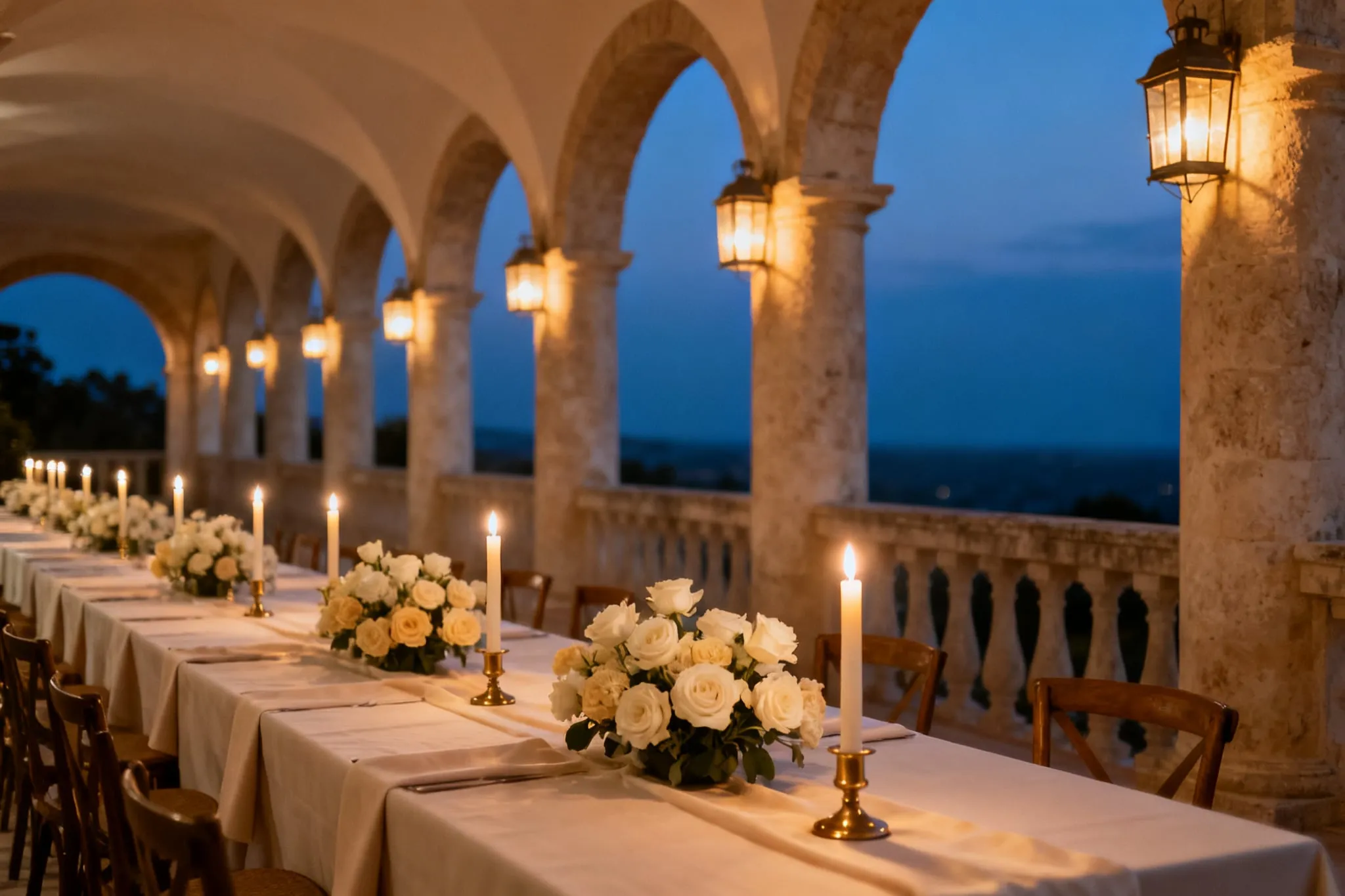
A venue is chosen once and then lived with for a year. The hour of the ceremony, what the light does to a dress, how far guests travel between the vows and the first course, whether anyone can hear the speeches: all of it is settled, quietly, by the location, long before anything else is booked.
The United Arab Emirates makes that decision unusually wide. Within a couple of hours’ drive there is a skyline that exists nowhere else, a coastline that stays warm when Europe does not, and a desert that goes completely silent at dusk. The question is not which of them is most impressive. It is which one a couple can look at in a photograph in forty years and still recognise as their own.
Dubai, and the argument for the city
Dubai has no interest in restraint, and that is exactly why it works as a backdrop: it commits. A ceremony here is set against something declarative — water, glass, height — and the styling has to be quiet enough to let the setting speak. Couples who over-dress a Dubai venue end up with two things competing in every frame.
Atlantis The Royal and the Burj Al Arab trade on that scale directly, and suit couples who want the city named in the photographs. Madinat Jumeirah works differently: waterways, low buildings and courtyards, a celebration assembled from several rooms rather than staged in one. One&Only The Palm is the garden position, with the skyline held at a distance rather than pressed against the table.
One practical note that changes more than it sounds: in Dubai the ceremony hour is set by the sun, not by the invitation. Late light on water is the most valuable thing a city venue owns, and it does not last long.
Abu Dhabi, and the argument for quiet
Abu Dhabi is the calmer register. Weddings here tend to move more slowly, with more formality and less spectacle, which is a preference rather than a compromise.
At Emirates Palace Mandarin Oriental the tone is set on arrival, before anyone reaches a room: the approach, the scale, the marble. Formality is built into the building, so it does not have to be imported. The St. Regis Saadiyat Island Resort is the other Abu Dhabi position — beach, low dunes, the Gulf doing most of the decorating. Couples who choose the capital are rarely asking for less. They are asking for a celebration that does not have to raise its voice.
The desert, and what it asks in return
Desert weddings are not a novelty in the Emirates; they are one of the country’s established forms. Al Maha and Bab Al Shams within reach of Dubai, Qasr Al Sarab out in Abu Dhabi’s Liwa, The Ritz-Carlton Al Wadi Desert in Ras Al Khaimah: each stages the same essential evening, a ceremony as the light goes, dinner under an open sky, and guests who stay the night because leaving is not practical.
The desert also asks for more than it appears to. There are no walls, so sound has to be built rather than contained. Heat governs both the season and the hour, which is why these weddings sit in the cool months and start late in the day. Transfers stop being a detail and become part of the programme, and the guest list is effectively an overnight guest list. Handled early, none of that is visible. Handled late, all of it is.
Ras Al Khaimah, and the three-day wedding
Ras Al Khaimah puts mountains and coastline within the same afternoon, which suits a wedding that is not one evening but a weekend: a welcome dinner, a day by the water, treatments before the ceremony, a last dinner for whoever is still there. Guests unpack once.
That shape also solves the problem most destination weddings quietly have — the people who flew furthest see the least of each other. Spread across three days, a wedding stops being an event guests attend and becomes a place they were.
Judge a venue on the whole celebration, not on the ceremony. Ask what the room does at ten in the evening, where the older guests sit, and how far a tired child is from a bed.
What the venue is actually carrying
A day that appears effortless is a day that was decided months earlier. The venue team, the florist, the photographer and the lighting are working to one timeline, and the guests are meant to notice none of it: the ceremony starts when it was said to, drinks are poured while the portraits are made in the last good light, and nobody is asked to stand in the sun between courses.
In practice, venues are chosen on the parts nobody photographs. Where the couple can be alone for ten minutes. Where guests wait between the ceremony and dinner. Whether the kitchen can serve the room it is being asked to serve, and whether the drive from the hotel is twenty minutes or an hour with children in the car.
This is where a curated circle is worth more than a list. Bridal Edit Studio does not run venues or stage weddings; we hold the relationships and open them, and the people who do the work are people we have worked with before. That is the whole point of The Circle. Which venues we would put in front of a particular couple depends on the month, the number of guests and the emirate they intend to marry in, which is where a conversation begins.
The legal date runs on a separate calendar
Venue availability and marriage paperwork are two different calendars, and the paperwork is the less flexible of the two.
A civil marriage in Abu Dhabi is roughly three months to the appointment as standard. Ras Al Khaimah is about three weeks, and seven working days on its express route. Abu Dhabi’s express route is the only one that completes in one to two working days. The choice between the two emirates is therefore a trade between recognition and time rather than convenience: Abu Dhabi carries the broader international recognition, Ras Al Khaimah is markedly faster as standard. Both emirates, and the documents each requires, are set out across Getting Married in the UAE.
One further deadline is worth settling before a venue is confirmed, because it runs past the wedding day rather than towards it. If the certificate has to be recognised in another country, that happens after the marriage and follows one of two paths: some countries accept the MOFA-attested certificate directly, others require their own embassy in the chain. Neither is something a venue can absorb, and both are described on Embassy & Legalisation.
What is left afterwards
Couples forget the arrangements. What they keep is the sequence — the walk towards the ceremony, warm air after sunset, dinner by candlelight, the last hour under an open sky — and the venue is the single decision that sets all four. It is also why the record of the day is better made as an object than a link, which is the argument behind The Editions.
Questions couples ask
Which are the UAE’s best-known wedding venues?
In Dubai: Atlantis The Royal, the Burj Al Arab, One&Only The Palm and Madinat Jumeirah. In Abu Dhabi: Emirates Palace Mandarin Oriental and The St. Regis Saadiyat Island Resort. For the desert: Al Maha, Bab Al Shams, Qasr Al Sarab and The Ritz-Carlton Al Wadi Desert. Best known and best suited are different questions, and only the second one matters once the guest list is written.
Is a desert wedding a serious option or a photograph?
A serious option, and a long-established one. It works in the cool months, in the evening, with guests staying overnight and transfers treated as part of the programme rather than as an afterthought. It is the setting that punishes late planning most.
How do we choose between two venues we both like?
Visit both at the hour you intend to marry, not at the hour the viewing is offered, and walk the route a guest walks: car, entrance, ceremony, drinks, dinner, bed. The venue that holds up over that whole route is the one to book, even when the other photographs better in the middle of the day.
Start Your Wedding Journey
Whether you're beginning with the legal marriage, planning the day itself, or want the whole of it in one house — tell us where you are.

The legal beginning, the day itself, and the story kept in print.