Inspiration
Outdoor Wedding Venues in Dubai
Beach, desert, garden or rooftop? Explore Dubai’s outdoor wedding settings, the seasons that suit them and the questions worth asking.
4 November 2026 · 7 min read
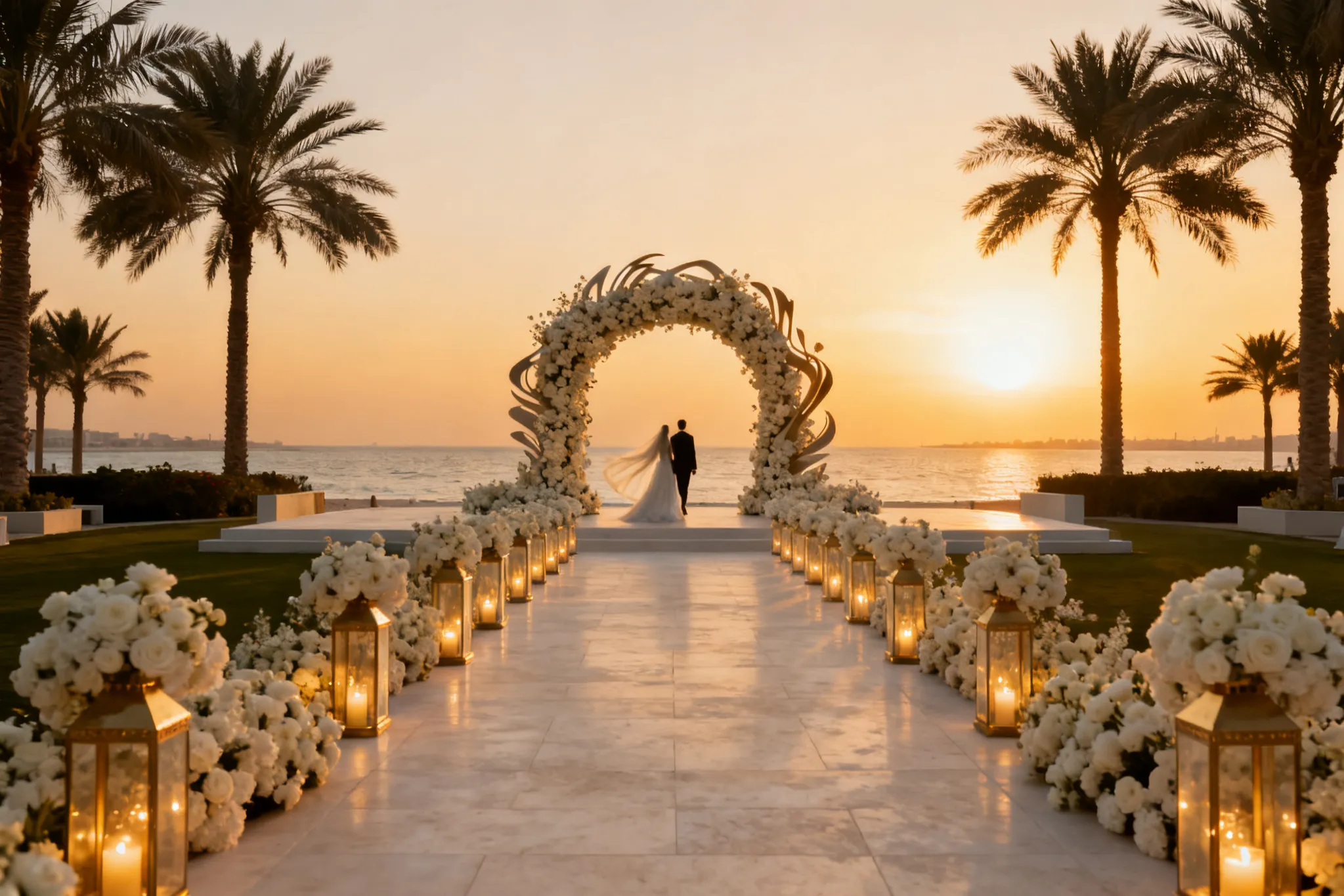
Outdoor wedding venues in Dubai: what should you know before choosing a beach wedding?
A beach wedding places the horizon at the centre of the occasion. It suits couples who want a sense of openness, natural light and a celebration that moves easily between the shore and an adjacent dining space. Before choosing the sand, however, ask exactly which part of the beach the venue can use and how the event will work there.
Not every beachfront venue offers the same experience. Some settings have a ceremony lawn or terrace overlooking the water; others may offer an area directly on the sand. The distinction affects shoes, seating, the aisle, photography and how guests reach their places. Ask to see the actual ceremony location rather than relying on an image of the wider property.
Light is another deciding factor. A beach that looks calm at midday may feel quite different towards sunset, when the horizon and the direction of the sun shape photographs and the atmosphere. A site visit, or a detailed video walkthrough at the proposed hour, can reveal far more than a gallery.
Consider the transition after the vows. Will guests walk to dinner, move indoors, or stay by the water? Is there a comfortable alternative if the weather is unsuitable? For a destination wedding, the best beach setting is the one that can hold the entire sequence of the day; a dramatic view alone does not decide it.
Why does the hour matter so much for a desert wedding?
In the desert, the hour is part of the setting. The colour of the sand, the changing shadows and the distance from the city give a ceremony its character. A desert celebration works best when its schedule is planned around those qualities rather than around a standard hotel timetable.
Elaborate styling is optional here. Open space and warm evening light can carry much of the visual story. A restrained ceremony structure, considered seating and a clear path for guests may allow the landscape to remain the strongest element.
The practical questions are equally important. How will guests arrive? How long is the journey from their accommodation? Where will they gather before the ceremony, and what happens after sunset? Ask the operator to explain the complete guest journey, including transport, lighting, facilities and the move into dinner.
A desert setting also asks couples to think carefully about footwear, wind and the difference between a brief outdoor ceremony and an entire evening spent outside. The answer should come from the specific site and its team, not from assumptions about every desert venue.
For couples planning from abroad, request images of the space at the intended hour and ask what is already provided on site. The landscape may look effortless in photographs, but the experience depends on thoughtful preparation.
What makes gardens and courtyards good wedding settings?
Gardens and courtyards offer a more enclosed kind of outdoor celebration. Where a beach opens towards the horizon and the desert towards the landscape, a garden can create a sense of intimacy through greenery, architecture and the way guests move between spaces.
A courtyard may be particularly appealing when the ceremony and dinner are intended to feel connected. Its walls, planting or surrounding buildings can provide a natural frame without requiring the couple to construct an entirely new visual setting.
Before choosing one, look beyond the first photograph. Is the garden shaded at the proposed hour? How does the light fall across the ceremony area? Are there separate places for drinks, dinner and photographs, or will the same area need to be transformed between moments?
Ask how the venue maintains the outdoor space across the year and whether planting, furniture or the appearance of the garden changes seasonally. The setting you see in a promotional image may not be identical to what is present on your chosen date.
Gardens also reward a considered approach to decoration. If the space already has strong greenery or architectural detail, adding more is not always an improvement. Let the place establish its own visual language before deciding what needs to be brought in.
When does a rooftop or terrace wedding work best?
A rooftop or terrace wedding makes the city part of the celebration. It is a natural choice for couples who are drawn to Dubai’s skyline, evening lights and a more architectural atmosphere than a beach or garden offers.
The first question is whether the rooftop is intended for a full wedding or for one part of it. A terrace may be ideal for vows or a drinks reception while dinner takes place indoors. Another space may be designed for the entire celebration. Ask the venue to describe what is possible for your guest count and preferred layout.
Consider the view from the guests’ perspective, not only the photographer’s. A skyline can be spectacular, but seating orientation, railings, surrounding structures and the position of the sun all influence how the ceremony feels. A walkthrough at the relevant hour is especially useful.
Wind and sound also deserve attention. Ask how the venue handles music, microphones, lighting and a change in weather. An outdoor terrace should have a clear alternative that preserves the character of the event rather than leaving the couple to improvise.
One of the strengths of a rooftop is the transition from daylight to the illuminated city. Couples who value that atmosphere may prefer to build the schedule around the changing light instead of expecting the same view throughout the day.
Which months suit an outdoor wedding in Dubai – and which are less comfortable?
The cooler part of the year is generally the more suitable starting point for an outdoor wedding, but the setting and hour still matter. Rather than treating every month as interchangeable, use the UAE National Center of Meteorology’s climate information and ask each venue about conditions in its specific outdoor space.
Tori Arthur, a Signature hair and make-up artist in The Circle, describes November to March as her busiest wedding period. She has noticed that some couples underestimate how hot October can still feel. In her experience, peak-season weddings sometimes begin around 2 or 3 pm, whereas celebrations in hotter weather tend to start closer to 5 pm.
Atrin, a Signature photographer and filmmaker in The Circle, sees outdoor weddings concentrated from November to April, with summer events moving mostly indoors in her experience. She identifies late October and early November as the beginning of the busier season, and December as particularly active for her work.
These are two professionals’ observations, not universal rules about every Dubai venue. They are useful because they show how seasonality changes the actual design of the day: the hour of the ceremony, how much time guests spend outdoors and where photographs are taken.
A date in September or October should not be chosen on the assumption that it will feel like autumn in Europe. Equally, a summer wedding need not abandon its visual ambitions; it may simply require a stronger indoor setting and shorter outdoor moments.
For a fuller discussion of the wedding calendar, read The Best Time to Get Married in the UAE.
What should you ask an outdoor wedding venue before booking?
Ask about the exact ceremony space, not just the property. The most useful questions are practical: where will guests sit, what time is the light most suitable, how will people move to dinner, and what is the alternative if the outdoor plan cannot be used?
Request a proposed layout for your approximate guest count. Ask whether the ceremony, drinks and dinner can happen in separate areas, and what needs to change between them. If the location is remote, understand the transport and arrival plan before treating the venue as confirmed.
Ask the venue what it can arrange on the particular beach, desert site, garden or terrace, and whether any location-specific approvals or restrictions affect your intended event. Do not assume that a beautiful outdoor setting is automatically available for every kind of ceremony.
Discuss the sound, lighting, access for suppliers and the timing of set-up. These details are not glamorous, but they influence whether guests experience the day as calm and coherent.
Finally, ask for photographs or video from the same season and time of day as your proposed wedding. A venue should be chosen for how it works on your date, not only for how it looks in its strongest promotional image.
The right outdoor venue is the one whose natural character matches your plans and whose practical arrangements support them. We are curating the venues in The Circle as a starting point for finding that setting.
Start Your Wedding Journey
Whether you're beginning with the legal marriage, planning the day itself, or want the whole of it in one house — tell us where you are.
The legal beginning, the day itself, and the story kept in print.