Inspiration
Choosing a Venue That Tells Your Story
Desert, beach, rooftop or skyline — reading a location for the narrative it already holds.
3 October 2026 · 5 min read
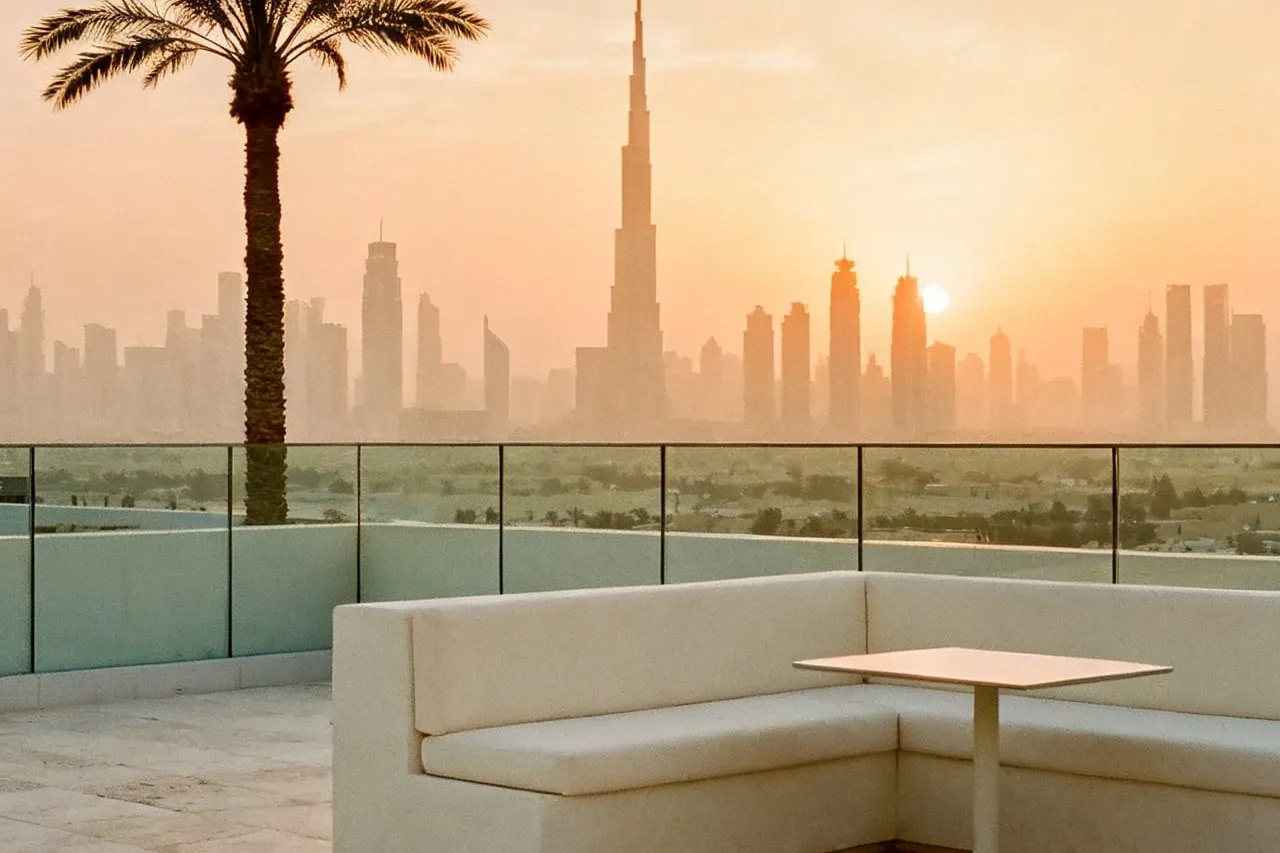
A wedding venue should do more than accommodate a guest list. The right place already carries part of the atmosphere, so you do not have to create all of it yourself.
Choosing a wedding venue often begins with practical questions: How many people can it hold? Is the date available? What can be changed? What does the space include?
They matter. But they are not necessarily where the decision should begin.
Before discussing flowers, layouts or styling, stand in the space and ask a different question: how does it make you feel?
A venue already has a personality before a wedding is added to it. Architecture, proportions, materials, views, light and even the journey towards it influence the experience. The strongest choice is often the place that already feels close to the story you want the day to tell.
What should you notice before you start planning the room?
Notice what is already there before deciding what you need to add. A venue with a strong identity should not need to be disguised before it feels like your wedding.
Look beyond the empty tables and the sample set-up you may be shown on a site visit. Notice the ceiling height. The floor. The windows. The distance between indoors and outdoors. Where your eye naturally travels when you enter.
Then listen to the room.
Does it feel intimate or expansive? Formal or relaxed? Quiet or energetic? Does it invite people to stay in one place, or does it naturally encourage them to move?
Those qualities matter because your wedding will inherit them.
When we planned our own wedding celebrations, we did not begin by trying to find one setting capable of representing everything we wanted. Different moments were allowed to have different characters.
Downtown gave us the urban energy we wanted for our engagement dinner. Other parts of the celebration took us onto the water and to the beach. For the ceremony itself, however, we wanted something completely different: the desert.
The choice was not about adding more spectacle. It was the opposite. Sand, open space and the natural landscape felt grounding and elemental. At golden hour, very little needed to compete with what was already there.
That experience still influences the way we think about venues: first understand what the place gives you; only then decide what you need to give the place.
Why does the hour of your wedding matter?
Because you are not really choosing one venue — you are choosing that venue at a particular hour.
Visit a space at midday and return towards sunset, and it may feel entirely different.
Natural light changes colour and texture. A terrace that appears exposed earlier in the day may become atmospheric in the evening. Glass, stone, water and metallic surfaces respond differently as the light changes. A skyline becomes another visual element after dark.
This is especially important when photographs matter to you.
Instead of thinking only about when the ceremony begins, consider the sequence around it. What will the light be like when guests arrive? Where will you be when the sun begins to fall? When will portraits happen? What will guests see when they sit down for dinner?
Our desert ceremony made this particularly clear to us. Golden hour was not simply a convenient time on the schedule. It was part of the visual language of the ceremony itself.
The hour belonged to the venue.
A site visit should therefore help you imagine the space at the time you will actually use it, rather than only as it appears during an appointment.
How do you know when to stop decorating?
Stop when the decoration begins competing with the reason you chose the venue.
It is easy to fall into the habit of filling every visible area: another floral installation, another backdrop, another table detail.
But a strong venue gives you something to edit against.
If you chose a space for its architecture, allow the architecture to remain visible. If the view is the reason you are there, avoid building something that obscures it. If the landscape already creates the atmosphere, styling can frame it rather than replace it.
This does not mean a wedding has to be minimal. It means every addition should have a reason.
Think about where guests will actually look and where photographs will naturally happen. Concentrating styling in those moments can have more impact than treating every square metre as something that needs decoration.
Sometimes the most confident design decision is knowing what to leave alone.
What should you ask on a site visit?
Ask questions that reveal how the venue will actually work on your wedding day, not only how it looks during the tour.
Start by walking through the day in order.
Where will guests arrive? What will they see first? Where will they wait? How will they move between the ceremony, drinks and dinner? If different parts of the wedding happen in different spaces, how long does that transition really take?
Then look at the practical details that can change the experience.
Ask what is included in the space and what must be brought in. Understand which areas are private and which may still be used by other guests. Ask when suppliers can access the venue, what restrictions apply to installations and when everything must be removed.
For outdoor elements, ask what the venue does if conditions change. Do not simply ask whether there is a Plan B; ask to see it.
And stand where the important moments will happen.
Look from the ceremony position towards the guests. Sit where your guests will sit. Walk the route they will take. Look at the background where photographs are likely to be made.
A floor plan can tell you whether everything fits. It cannot tell you whether the experience flows.
How do you choose the venue that feels like yours?
Choose the place that needs the least explanation.
When you walk into the right space, you should already recognise something you wanted the wedding to become.
That might be intimacy, scale, movement, stillness, architecture, landscape or light. There is no single quality a wedding venue needs to have.
The point is to know why you chose it.
Our own celebrations moved between very different moods — the city, the water, the beach and the desert. Later moments could feel more celebratory and glamorous again, from an intimate get-together to New Year’s Eve on the water. What connected them was not identical decoration. Each setting had a role in the story.
That distinction can be useful when a wedding includes several moments. Instead of asking every place to create the same atmosphere, decide what each part of the celebration is meant to feel like. Then choose a space that already carries some of that feeling.
Only after that should the layers begin: furniture, flowers, lighting, stationery, music and all the details that make the space personal.
The venue provides the first chapter. The design continues it.
For couples beginning that search, Bridal Edit is curating wedding venues in Dubai with a story of their own for The Circle: places to consider for the experience they can create.
Because the most memorable venue does not need to become something else for your wedding. It already gives you somewhere to begin.
Start Your Wedding Journey
Whether you're beginning with the legal marriage, planning the day itself, or want the whole of it in one house — tell us where you are.
The legal beginning, the day itself, and the story kept in print.